Governments shape how societies function—how laws are made, how leaders are chosen, and how power is distributed. Over history, different types of governments have evolved based on culture, ideology, and social needs. Understanding these systems helps us better appreciate political structures around the world.
This blog provides a simple, structured overview of the major types of governments, followed by a comparison table outlining their advantages and disadvantages.
What Is a Government?
A government is the authority that manages a country or state. It creates laws, enforces rules, manages public resources, and represents the nation internally and externally.
Governments can be classified based on:
- Who holds power
- How leaders are selected
- How authority is exercised
Major Types of Governments Explained
1. Democracy
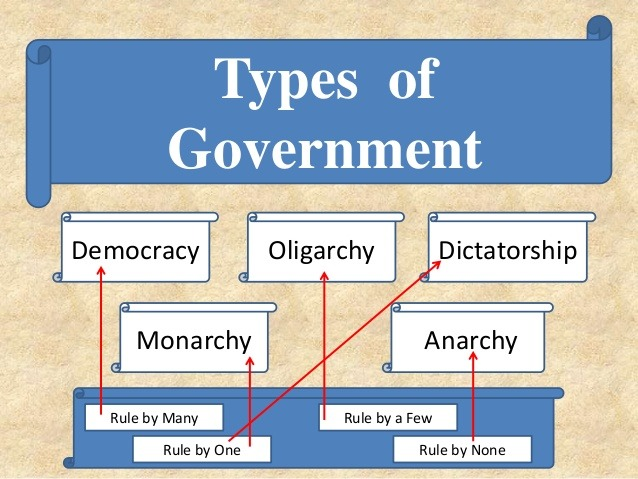
Power rests with the people, who participate directly or elect representatives.
Examples: Parliamentary democracy, presidential democracy
Core idea: Rule by the people
2. Monarchy
A single ruler (king, queen, emperor) governs, often for life and usually through heredity.
Types: Absolute monarchy, constitutional monarchy
Core idea: Rule by royal lineage
3. Dictatorship / Authoritarian Government
Power is concentrated in one leader or a small group, with limited political freedom.
Core idea: Centralized control and obedience
4. Oligarchy
A small elite group (wealthy, military, or political class) controls the government.
Core idea: Rule by the few
5. Theocracy
Government is run according to religious law, and leaders are often religious authorities.
Core idea: Rule by religious doctrine
6. Federal Government
Power is divided between a central authority and regional/state governments.
Core idea: Shared governance
7. Socialism (as a governing system)
The government plays a major role in owning or regulating resources to promote equality.
Core idea: Collective welfare over individual profit
8. Communism
A classless system where the state controls all property and production.
Core idea: Absolute economic equality
Pros and Cons of Different Types of Governments
| Type of Government | Key Features | Pros | Cons |
|---|---|---|---|
| Democracy | Citizen participation, free elections | Protects individual rights, promotes accountability | Slow decision-making, risk of populism |
| Monarchy | Hereditary ruler | Stability, clear leadership | Lack of public choice, risk of misuse of power |
| Dictatorship / Authoritarian | One-party or single-leader rule | Fast decision-making, strong control | Human rights violations, no political freedom |
| Oligarchy | Power held by elites | Efficient governance | Inequality, ignores public interest |
| Theocracy | Religious laws govern state | Moral consistency, cultural unity | Religious intolerance, limited freedom |
| Federal Government | Power shared with states | Balanced authority, regional autonomy | Jurisdictional conflicts, complex administration |
| Socialism | State-regulated economy | Reduced inequality, social welfare | Lower innovation, heavy taxation |
| Communism | State-owned economy | Economic equality | No personal freedom, inefficiency |
Final Thoughts
No single government system is perfect. Each type reflects a balance between power, freedom, efficiency, and equality. While democracies emphasize participation and rights, authoritarian systems prioritize control and speed. Understanding these differences allows citizens to engage more thoughtfully with political systems and governance debates.