History of Morse code.
Morse code was invented by Samuel Morse and Alfred Vail in the 1830s as a system for sending messages over an electric telegraph. The first successful transmission occurred in 1844 between Washington, D.C., and Baltimore, using a series of dots and dashes to represent letters and numbers, which revolutionised long-distance communication. It is a method of communication that uses a series of dots (•) and dashes (—) to represent letters, numbers, and punctuation. It is transmitted through sound, light, or written marks.
Rules of reading Morse code.
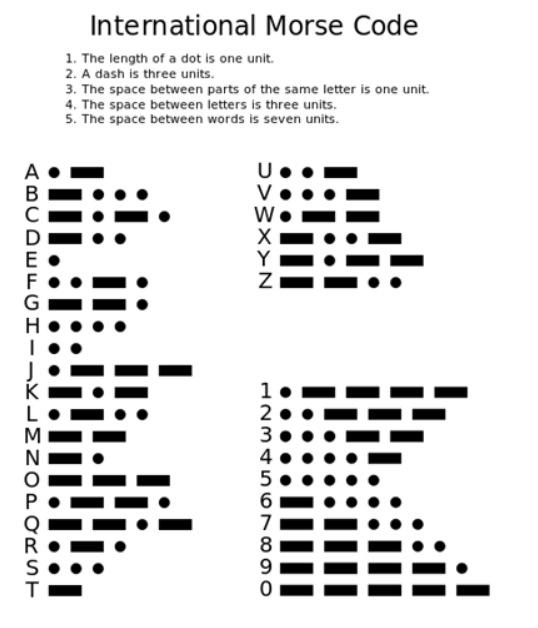
To read Morse code, understand its basic elements (dots/dits, dashes/dahs), their relative durations (dah=3 dits), and the crucial spacing: 1 unit between elements in a letter, 3 units between letters, and 7 units between words, all timed by listening for the rhythm and pauses to decode the rhythmic patterns of sounds or signals representing letters, numbers, and punctuation.
Morse code chart
Practice Morse code.
Morse code is a sound-based system, hence, rather than focusing on the picture for the alphabet and the number from the above diagram, we should convert all the letters and the numbers to words that we already know. Then practice saying the word say the word in such a manner that it resembles the system of dih/dot and dah/dashs for the specific alphabet and number.
Step 1:
A -> Apple
B -> Bubble
C -> Cucumber
Step2:
A= dih(1 unit) & dah(3 units) hence say “Apple” as “ah-apppllle”
B= dah(3 units) & dih(1 unit) & dih(1 unit) & dih(1 unit) hence say “Bubble” as “Buuuuh-ba-ba-ble”
C= dah(3 units) & dih(1 unit) & dah(3 units) & dih(1 unit) hence say “Cucumber” as “Cuuuuu-cum-baaaaaaa-rr”
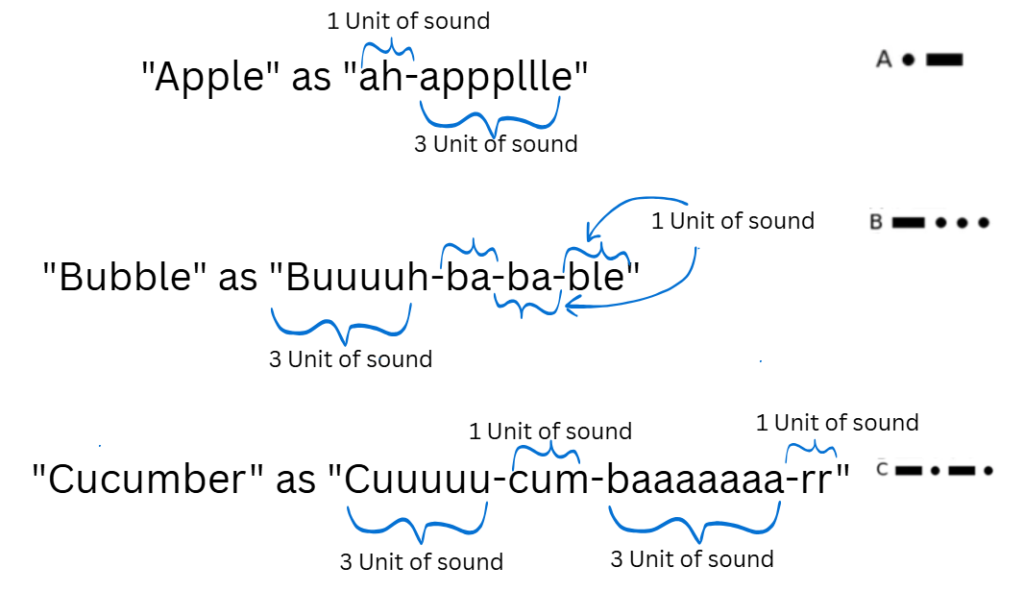
Similarly, you can make your own words or refer to the chart below for the list of words, but I would recommend using your own words so that you will remember things more clearly and for a longer time.
Alphabets
| Letter | Morse | Word | How To Say It (Morse style using the word) |
|---|---|---|---|
| A | •– | Apple | Ap – pleeee |
| B | –••• | Bubble | Buuuu – ble – ble – ble |
| C | –•–• | Candle | Caaaaan – dle – caaaan – dle |
| D | –•• | Donut | Doooo – nut – nut |
| E | • | Egg | Egg (quick) |
| F | ••–• | Flower | Flo – wer – flooower – wer |
| G | ––• | Goooo – gleee – gl | |
| H | •••• | Happy | Ha – ppy – hap – py (all quick) |
| I | •• | Igloo | Ig – loo (quick-quick) |
| J | •––– | Jelly | Jel – leeeee – leeee – leeee |
| K | –•– | Kite | Kiiii – te – kiii |
| L | •–•• | Lemon | Le – moooon – mon – mon |
| M | –– | Monkey | Monkeeeey – monkeeeey (2 long) |
| N | –• | Noodle | Noooo – dle |
| O | ––– | Orange | Oooo – oooo – oooo |
| P | •––• | Paper | Pa – perrrrr – perrrrr – pa |
| Q | ––•– | Queen | Queeeee – een – queeee – en |
| R | •–• | Rabbit | Rab – biiit – bit |
| S | ••• | Sun | Su – Su – Sun (quick) |
| T | – | Tiger | Tiiiiiger |
| U | ••– | Unicorn | Uni – corn – coooorn |
| V | •••– | Violin | Vi – o – lin – liiiiin |
| W | •–– | Water | Wa – teeeer – teeeer |
| X | –••– | Xylophone | Xyyyyy – lo – lo – phoooooone |
| Y | –•–– | Yellow | Yellooooo – ow – ooow – ow |
| Z | ––•• | Zebra | Zeeebraaa – bra – bra |
Numerals
| Num | Morse | Word | How To Say It (Morse style using the word) |
|---|---|---|---|
| 0 | ––––– | Zero | Zeeee – roooo – zeeee – roooo – roooo (5 long) |
| 1 | •–––– | One | One – oooo – oooo – oooo – oooo |
| 2 | ••––– | Two | Two – two – tooooo – tooooo – tooooo |
| 3 | •••–– | Three | Three – three – three – thuuuu – thuuuu |
| 4 | ••••– | Four | Four – four – four – four – fooooor |
| 5 | ••••• | Five | Five – five – five – five – five (quick 5) |
| 6 | –•••• | Six | Siiix – six – six – six – six |
| 7 | ––••• | Seven | Seveeen – se – se – sen |
| 8 | –––•• | Eight | Eiiiight – eight – eight – ate – ate |
| 9 | ––––• | Nine | Niiiiine – nine – nine – nine – ni |
Benefits of learning Morse code.
Learning Morse code provides cognitive benefits, such as improved memory, concentration, and problem-solving skills. It also offers practical advantages, including its versatility for communication in various situations and its historical and ongoing use in fields like amateur radio, aviation, and maritime operations. Additionally, it can assist with language learning and be a tool for people with disabilities.