If you can draw a dot, you can draw a line, if you can draw a line, you can draw a rectangle, a sqare. If you master these designs and combine them with circle and oval design, you can litrally draw anything… it won’t be a Picasso but it will work enough to explain basic and intemidiate things.
Drawing may feel tricky, but it all based in simple 4 shapes: dot, rectangle, triangle and circle. NowWe’ll explore how connecting basic shapes leads to drawings. How to break down a drawing into 4 basic shapes and connect them to make a drawing.
Step 1: Start with Basic Shapes
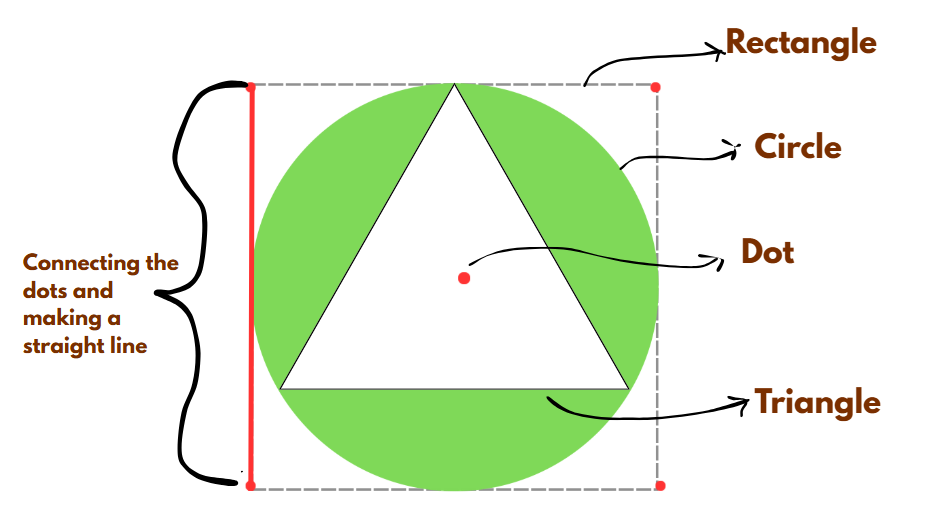
Begin with two dots. Connect them — now you’ve made a line.
Draw more lines, and you can build squares, circles, and triangles.
🔹 Everything you want to draw — animals, objects, even people — can be broken into these shapes.
Example: A truck
Look closely… the tyre is a circle, the body is an rectangle, the front part is triangular.
But don’t forget what’s around it — negative space helps define the proportions too.
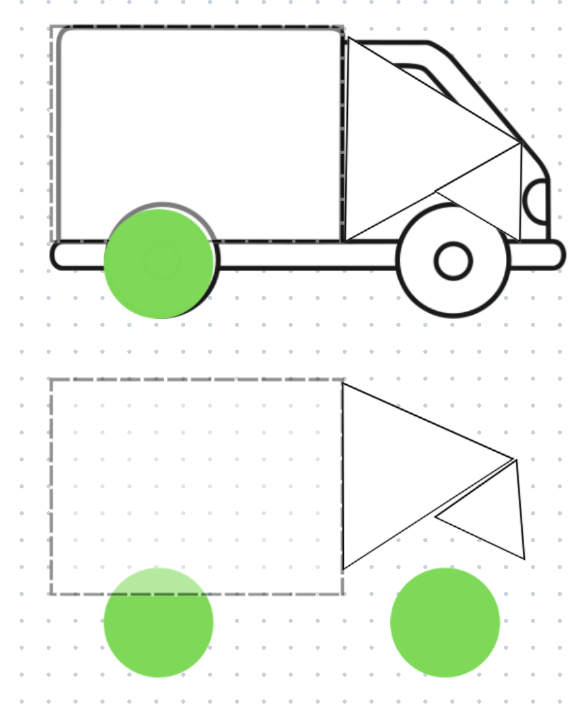
Tip: You can trace at first, but observing shapes in real life will help you improve faster.
Step 2: Turn Shapes Into 3D
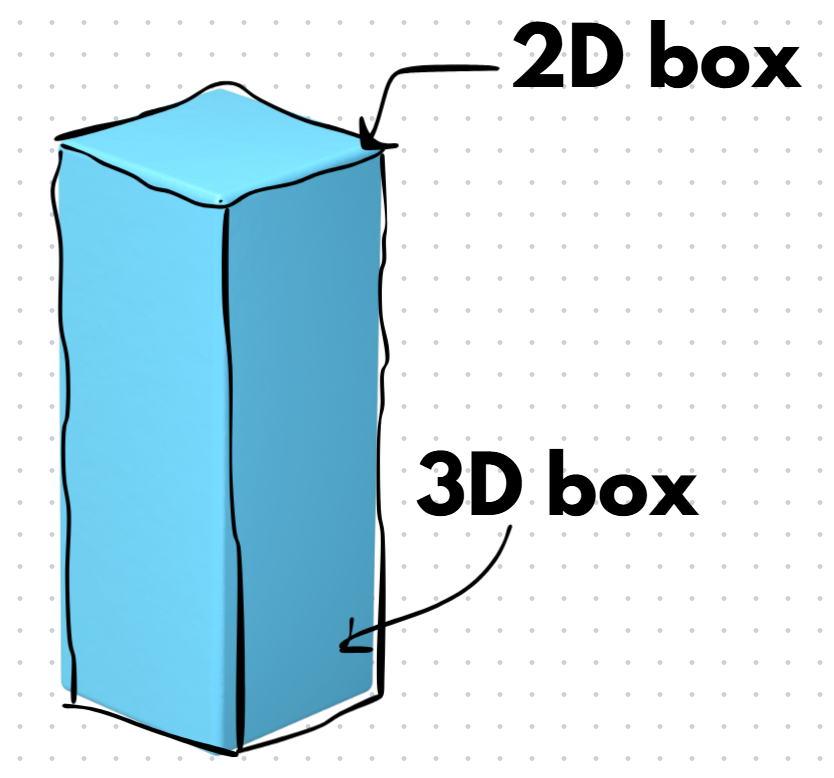
To draw realistically, we need depth.
Try this:
1 Draw a square
2 Draw another square behind it
3 Connect the corners → A cube!
Do the same with triangles and circles:
- Two triangles → Pyramids
- Two squashed circles (ellipses) → A cylinder
Add curved lines along a cylinder and you’ll see how curvature shows direction.
Practice spirals too — they strengthen your understanding of how forms twist in space.
Step 3: Learn Perspective — The Game Changer
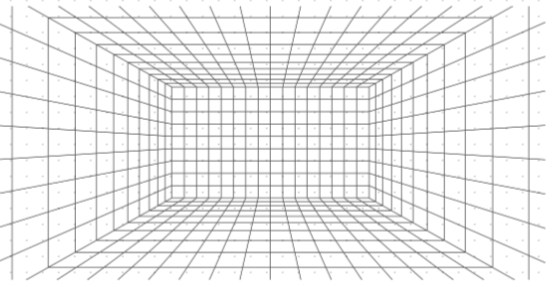
Perspective helps objects feel grounded and real.
One-Point Perspective
- Draw a horizon line
- Add a single vanishing point
- Use that point to guide depth
Objects:
- Above horizon → Bottom visible
- Below horizon → Top visible
- Right/Left of center → Opposite side visible
Great for indoor scenes.
Step 4: Apply It — Draw the Truck in 3D
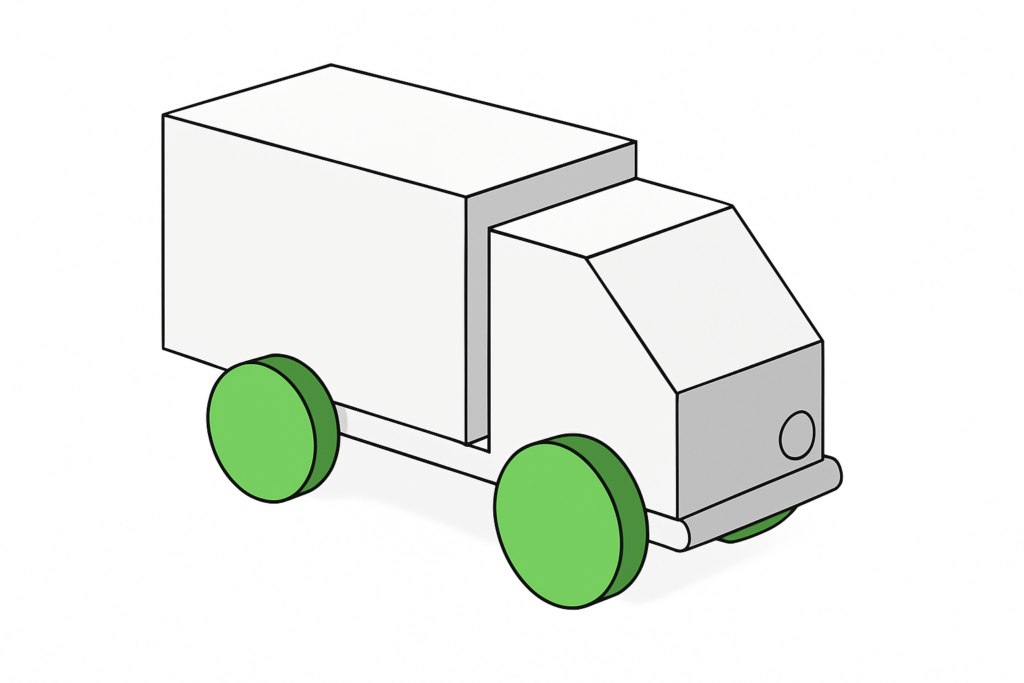
Now put it all together:
- Break the duck into basic shapes
- Fit those shapes inside a 3D box (perspective guide)
- Compare relationships between shapes and negative spaces
- Add volume by deciding how “thick” the form is
- Smooth the shapes and refine details
Congratulations — you just built a 3D duck!
Hence in a summary, we can say that basically everything can be broken down to basic shapes.
✍️ Ready to Practice?
Here are a few quick exercises:
| Exercise | What It Builds |
|---|---|
| Break objects into basic shapes | Observation & proportion |
| Draw cubes and cylinders from different angles | 3D thinking |
| Practice one- and two-point perspective | Depth & realism |
| Sketch wireframe animals | Organic structure |
The more shapes you draw, the more confident your lines become. Don’t worry about perfection — sketch, erase, explore, play.
Because once you understand shapes…
you can draw anything you imagine.